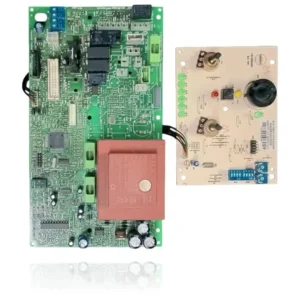


























































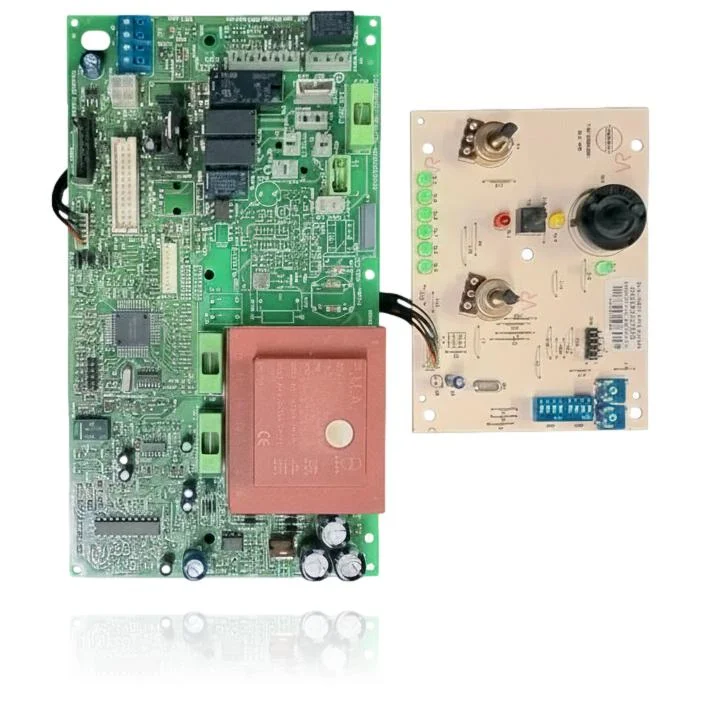
Ariston Control PCB B60 30 Bffi Ref. 65119997
If your boiler does not start, locks out, or behaves erratically, you may need the Ariston B60 30 Bffi Control PCB Ref. 65119997. This control PCB manages the ignition, burner modulation, pump, and safety features of the boiler. Errors such as 301, 302, 303, 305, and 306 may indicate faults in this component. It is compatible with several models, including the B60 28BI, 30BFFI, DEA 24 BFFI, and RIO 24 BI, among others. It is recommended to replace it if you experience any of these issues or errors.
Ariston boilers compatible with reference 65119997
PCB with reference 65119997. 17 verified compatibilities: 28BI and 30BFFI.
Proven compatibility
| Boiler model | Family | Verification |
|---|---|---|
| Ariston 28BI | B60 | Contrasted |
| Ariston 30BFFI | B60 | Contrasted |
| Ariston 24 BFFI | DEA | Contrasted |
| Ariston 24 BI | DEA | Contrasted |
| Ariston MAXI 28 / 60 BI | DEA | Contrasted |
| Ariston MAXI 30 / 60 BFFI | DEA | Contrasted |
| Ariston MAXI 24 / 60 BFFI | GENIA | Contrasted |
| Ariston MAXI 24 / 60 BI | GENIA | Contrasted |
| Ariston MAXI 28 / 60 BI | GENIA | Contrasted |
| Ariston MAXI 30 / 60 BFFI | GENIA | Contrasted |
| Ariston 30 BFFI Plus | GENUS | Contrasted |
| Ariston STORAGE 24 BFFI | NEW | Contrasted |
| Ariston STORAGE 24 BI | NEW | Contrasted |
| Ariston 24 BCSI | RIO | Contrasted |
| Ariston 24 BI | RIO | Contrasted |
| Ariston MAXI 28 / 60 BI | RIO | Contrasted |
| Ariston MAXI 30 / 60 BFFI | RIO | Contrasted |
Can't see your model or have questions? The printed reference takes precedence. How to check it · Send us a photo via WhatsApp.
How to check if the part number 65119997 is the one for your boiler.
What determines it is not the boiler model, but the reference printed on the part you already have installed.
- Find the reference printed on the installed part and check whether it matches the catalogue reference 65119997. If it is not visible, do not identify the part from its shape alone.
- Check the full boiler model on its data plate and look for it in the model associations on this page.
- Compare the connections and physical body with the original part before installation.
- If anything is unclear, send us a photo of the marking via WhatsApp before placing your order.
Symptoms and faults that the PCB 65119997 resolves
The PCB controls the ignition, modulation, and safety features of the boiler. These are the typical symptoms and what to do:
Common symptoms and faults
- 01
The boiler does not ignite and does not respond to any controls.
Cause: The power PCB does not distribute power to the rest of the system.
Check that power is reaching the PCB and inspect the fuse before replacing it.
- 02
The indicators or the display are completely off.
Cause: A fault in the control board cuts off the power to the visible part of the boiler, although the rest is functioning.
Check the connector between the power PCB and the control PCB, ensuring that it is not loose or corroded.
- 03
The boiler fails intermittently without any visible mechanical cause.
Cause: A relay or component on the power board intermittently fails when switching the load.
Check if the relay makes an audible click when turned on; if it doesn't sound or sounds irregular, point to the PCB.
- 04
The boiler stops by itself even though it was working normally moments before.
Cause: A faulty contact in either of the two PCBs cuts the control signal without warning.
Check that both PCBs fit well into their connectors and have no play before replacing them.
Fault codes for Ariston that this part resolves.
| Code | Fault | Diagnosis and solution |
|---|---|---|
| 301 | EEPROM display error | EEPROM memory of the PCB (display/main) corrupted or unreadable; check 5V/3.3V on the PCB and the display/BUS harness. If it persists after reset, replace/reprogram the PCB. |
| 302 | Electronic communication fault | Communication fault between the main PCB and display/interface; check the continuity of the BUS/connectors. If the wiring is OK, it is usually a PCB fault. |
| 303 | Main PCB fault | Self-diagnosis detects an internal fault in the main PCB; check voltages/regulators and moisture damage. If everything is correct and the error persists, replace the PCB. |
| 305 | Main PCB fault | Internal fault of the main PCB; check low voltage supply and connectors. If there are no external anomalies, replace the board. |
| 306 | Main PCB fault | Recurrent internal fault in the PCB; check 5V/12V, perform visual inspection and test with a known PCB. If confirmed, replace. |
| 307 | Main PCB fault | Internal fault of the main PCB; after checking wiring/power supply and ruling out external causes, proceed with replacing the board. |
| A 39 | MCU 1 fault | Microcontroller fault in the main PCB (lock/damage); check 5V and clock/crystal. If it does not start after reset and wiring is OK, replace the PCB. |
| A 40 | MCU 2 fault | Second level microcontroller fault on the PCB; same checks (power supply/oscillator). If it persists, replace the board. |
| E 37 | Communication problem with the main PCB | The interface is not communicating with the main PCB; check the harness and connectors between the display and main. If the BUS is correct, the main PCB is damaged. |
These symptoms can have more than one cause. If your boiler displays a fault code, send it to us via WhatsApp along with a photo of the labeling, and we'll tell you if this is the part.
Data sheet for the Ariston PCB 65119997
- Catalogue reference
- 65119997
- Brand
- Ariston
- Type of part
- PCBs (control boards)
- Units in stock
- 0 units
- Status
- Refurbished
- Warranty
- 1 year
- Shipping
- Delivery time shown at checkout
- Return
- 14 days
Data read on the part and in the manufacturer's documentation
What we have not been able to verify does not appear here.
- voltage
- 230V
- frequency
- 50Hz
Frequently asked questions about the PCB 65119997
How many PCBs does this spare part Ref. 65119997 for the Ariston Genus 30 BFFI Plus include?
Does this PCB Ref. 65119997 work for my Ariston Rio 24 BCSI?
Spare parts related to Ariston DEA