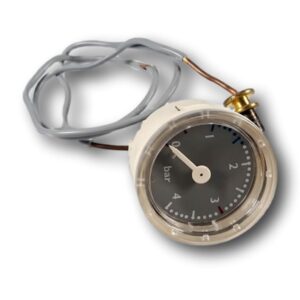


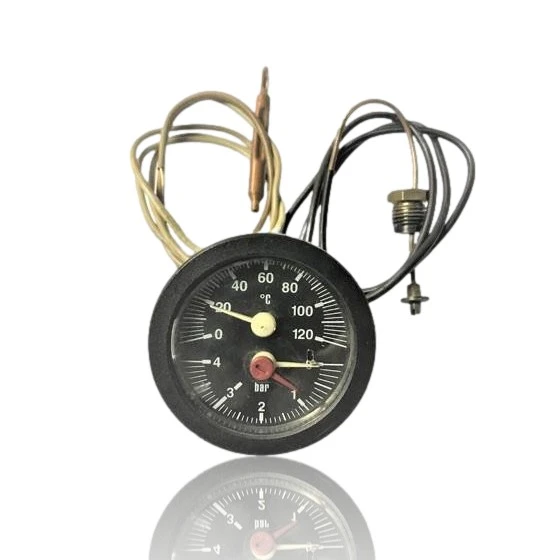
Pressure Gauge Ariston Basic 23 MFFI Boiler
If you notice incorrect readings in the pressure or temperature of your boiler, a technical diagnosis must confirm whether you need a new pressure gauge. The Ariston Basic 23 MFFI pressure gauge measures and controls the pressure and temperature of your boiler's circuit. When it fails, it can cause lockouts due to false low pressure or poor temperature regulation. This pressure gauge is compatible with several models in the BASIC range, such as the 23 M and the 23 MFFI, among others. A technician must confirm through diagnosis whether it is necessary to replace it when the readings become inaccurate or the boiler experiences operational issues.
- Type of part
- Pressure gauges & aquastats
- Status
- Refurbished
- internal SKU
- MAACU23MFFI
- Warranty
- 1 year
Compatible Ariston boilers
Manometer. Seven confirmed compatibilities: 23 M and 23 MFFI.
Proven compatibility
| Boiler model | Family | Verification |
|---|---|---|
| Ariston 23 M | BASIC | Contrasted |
| Ariston 23 MFFI | BASIC | Contrasted |
| Ariston 20 MFFI | DAY | Contrasted |
| Ariston 24 MFFI | DAY | Contrasted |
| Ariston 23 MFFI | EDY | Contrasted |
| Ariston 20 M | SX | Contrasted |
| Ariston 20 MFFI | SX | Contrasted |
Can't see your model or have questions? The printed reference takes precedence. How to check it · Send us a photo via WhatsApp.
How to check if it is the part for your boiler
The part reference, model, and equipment revision must be verified against the manufacturer's documentation.
- Find the reference printed on the installed part and check whether it matches the catalogue reference —. If it is not visible, do not identify the part by its shape alone.
- Check the full boiler model on its data plate and look for it in the model associations on this page.
- Compare the connections and physical body with the original part before installation.
- If anything is unclear, send us a photo of the marking via WhatsApp before placing your order.
Symptoms that require diagnosis on the manometer
The manometer shows the pressure of the boiler circuit. These are the typical symptoms and what to do:
Common symptoms and faults
- 01
The needle of the manometer always stays stuck at the same number, even though the actual pressure in the circuit rises or falls.
Cause: The internal mechanism of the pressure gauge has seized up and does not respond to changes in pressure.
Bleed a radiator and observe if the needle moves even slightly; if it doesn't react to a real pressure change, the pressure gauge is the one failing, not the circuit.
- 02
The glass is broken or fogged on the inside, making it difficult to clearly see the needle or the pressure or temperature scales.
Cause: Over time, moisture can get in or the glass can crack due to impact or heat, and the dial becomes unreadable even though the mechanism works.
Check if the problem is just visibility by cleaning the outside; if the moisture is inside the glass, no cleaning will fix it, and the part needs to be replaced.
- 03
The pressure gauge shows a reading that doesn't match what's expected, for example, it remains at zero after filling the circuit.
Cause: The internal pressure intake of the manometer may be blocked by lime or air, or the mechanism itself has lost calibration.
Repeat the filling and bleeding of the circuit slowly; if other signals from the boiler indicate that there is pressure and it starts without locking, the reading fault is with the pressure gauge.
- 04
The needle moves, but it does so abruptly or in jumps instead of rising and falling smoothly with the pressure.
Cause: The internal mechanism has friction that causes the needle to move in jerks instead of moving continuously.
Gently tap the glass while observing the needle: if it frees up with the tap, confirm an internal mechanical fault before replacing the part.
These symptoms can have more than one cause. If your boiler displays a fault code, send it to us via WhatsApp along with a photo of the labeling, and we'll tell you if this is the part.
Ariston pressure gauge datasheet
- Uniclima internal SKU
- MAACU23MFFI
- Brand
- Ariston
- Type of part
- Pressure gauges & aquastats
- Units in stock
- 6 units
- Status
- Refurbished
- Warranty
- 1 year
- Shipping
- Delivery time shown at checkout
- Return
- 14 days
Part data and available documentation
Contrast the label codes, PCB, and revision with the installed part; they are not necessarily equivalent references.
- Temperature range
- 40-120 °C
- Temperature scale
- 0 to 120 °C
- Pressure gauge
- 0 to 4 bar
Frequently asked questions about the pressure gauge
Is this manometer suitable for the Ariston Basic 23 MFFI?
Does this manometer also display the temperature on the Ariston Dia 24 MFFI?
When should this manometer be replaced in an Ariston Edy 23 MFFI?
Is this manometer suitable for the Ariston SX 20 M?
Spare parts related to Ariston BASIC