






























































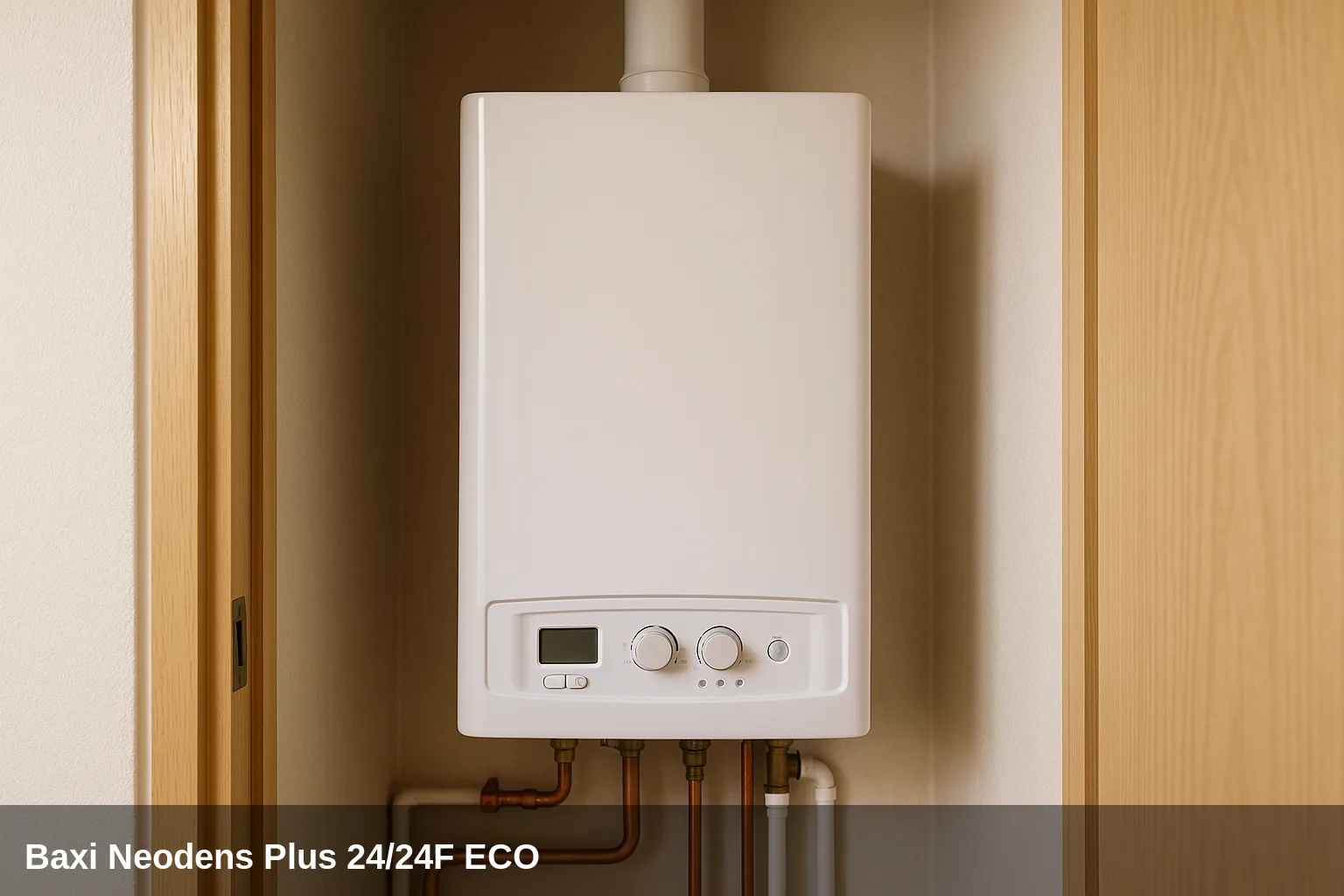
Short answer
The Baxi Roca Neodens Plus ECO boiler It is a wall-mounted gas condensing boiler (heating + domestic hot water) available in two power outputs: 24/24F and 28/28FManufactured by BDR Thermea under the Baxi Roca platform, it incorporates Gas Inverter technology, a modulating circulator, and a backlit LCD control panel, with an energy efficiency rating of class A. Fault codes are displayed on the screen with a prefix. E followed by a number and indicate the affected subsystem.
Error code table for Neodens Plus 24/24F and 28/28F ECO
Quick summary of all fault codes. Below you have the details of each one with its cause and solution.
| Code | Meaning |
|---|---|
| E09 | Gas valve connection fault |
| E10 | External sensor fault |
| E12 | Fault in the hydraulic differential pressure switch |
| E13 | Differential pressure switch contacts stuck |
| E15 | Control board fault in the gas valve |
| E18 | Automatic circuit filling process in progress |
| E19 | Anomaly during automatic filling |
| E20 | Heating flow NTC sensor fault |
| E28 | Flue gas NTC sensor fault |
| E40 | Return NTC sensor fault |
| E50 | Faulty domestic hot water NTC sensor |
| E53 | Flue duct obstructed |
| E55 | Uncalibrated PCB |
| E83 | Communication problem between the PCB and the control unit |
| E92 | Flue anomaly during the calibration phase |
| E109 | Presence of air in the heating circuit |
| E110 | Activation of the safety thermostat due to overheating |
| E117 | Excessive hydraulic pressure in the circuit |
| E118 | Insufficient hydraulic pressure in the circuit |
| E125 | Safety activation due to lack of circulation |
| E128 | Flame loss during operation |
| E129 | Flame loss during ignition |
| E130 | Activation of the flue gas NTC sensor due to overtemperature |
| E133 | Ignition fault after 5 attempts |
| E134 | Gas valve blocked |
| E135 | Internal error of the PCB |
| E160 | Fan fault |
| E162 / E317 | Incorrect power supply frequency |
| E163 / E321 | Faulty domestic hot water NTC sensor (accumulator) |
| E164 / E384 | Detection of parasitic flame |
| E165 / E385 | Electrical supply voltage too low |
| E119 | The water pressure switch does not switch or incorrect pressure |
| E131 | Power supply cut followed by anomaly |
| E151 | Internal error of the PCB |
| E154 | Sensor flow/return control fault |
| E178 | Overtemperature in low-temperature circuit |
What can you check yourself?
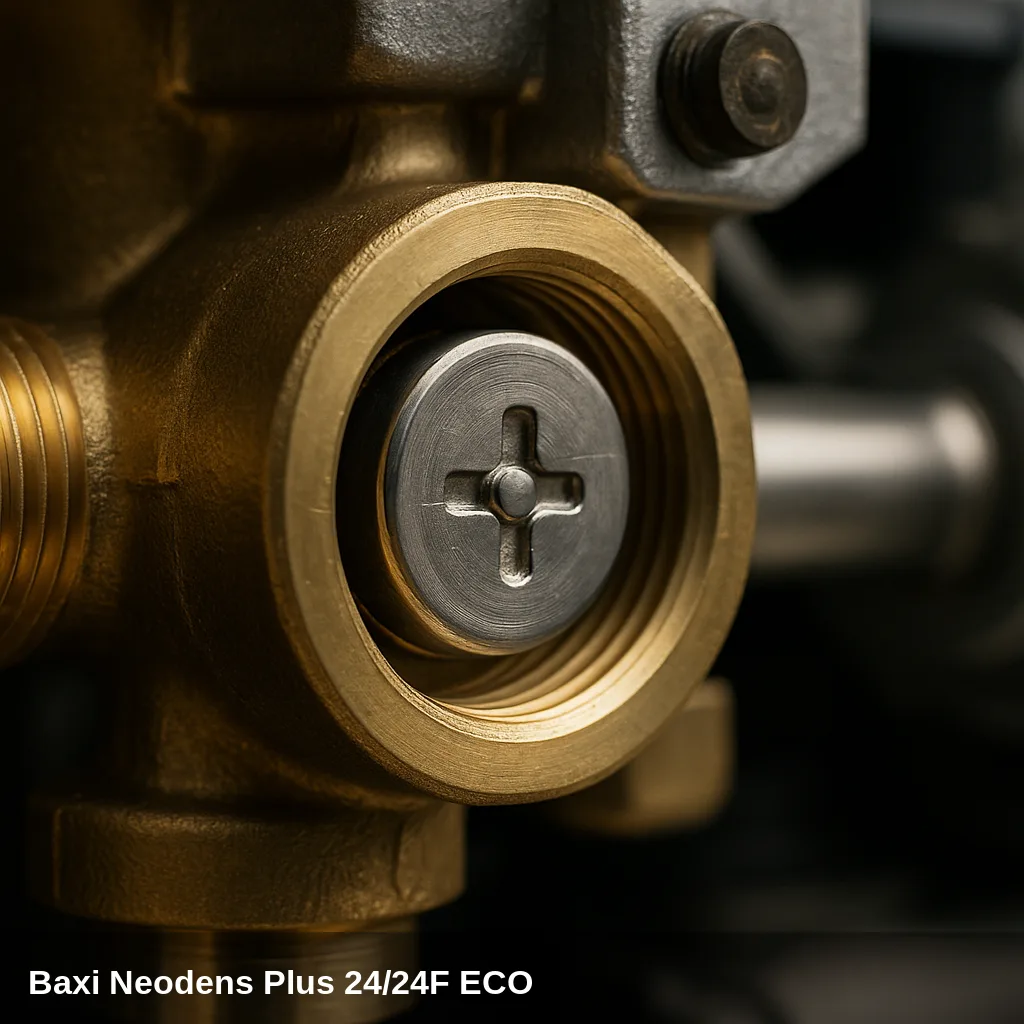
Some alerts can be resolved with simple and safe checks: replenishing the water pressure, bleeding the air from the radiators, checking that the gas valve is open, or resetting the boiler after a temporary lockout. If the code reappears after doing this, there is an underlying cause that should be reviewed by a qualified technician. Do not manipulate internal gas components nor electronics.
How to replenish the pressure step by step
- Locate the filling valve under the boiler.
- Open it slowly while observing the pressure gauge.
- Close the valve upon arrival at between 1 and 1.5 bar in cold.
- Bleed the radiators starting with the furthest one and check the pressure again.
- Reset the boiler; if the pressure warning disappears, the problem was resolved.
All fault codes and their solution
E09 — Gas valve connection fault
Why does it appear: Electrical fault in the gas valve wiring or defective gas valve
What to do: Check that the gas supply is open and press the reset button. If the error persists, a qualified technician should inspect the wiring and the gas valve.
Browse catalogue: Catalogue: gas valves · Baxi
E10 — External sensor fault
Why does it appear: Defective, disconnected, or poorly connected outdoor temperature sensor
What to do: The inspection, continuity check, and replacement of the external sensor must be carried out by a qualified technician.
Affected component: Temperature sensor
E12 — Fault in the hydraulic differential pressure switch
Why does it appear: The differential pressure switch is not switching correctly; it may be blocked or have a wiring fault.
What to do: Requires intervention by a qualified technician for inspection and replacement of the pressure switch.
Browse catalogue: Catalogue: spare parts · Baxi
E13 — Differential pressure switch contacts stuck
Why does it appear: The differential pressure switch contacts are stuck in the closed position.
What to do: Requires intervention by a qualified technician for inspection and replacement of the pressure switch.
Browse catalogue: Catalogue: spare parts · Baxi
E15 — Control board error in the gas valve
Why does it appear: Fault in the connections between the PCB and the gas valve, or defective PCB
What to do: Reset the boiler. If the fault persists, a qualified technician should check the connections of the gas valve to the PCB.
Browse catalogue: Catalogue: gas valves · Baxi
E18 — Automatic circuit filling process in progress
Why does it appear: The boiler is running the automatic filling cycle of the hydraulic circuit.
What to do: Wait for the process to complete. If the fault is displayed permanently, contact a qualified technician.
Browse catalogue: Catalogue: spare parts · Baxi
E19 — Anomaly during automatic filling
Why does it appear: Fault in the filling valve or problem during the automatic filling cycle of the circuit
What to do: Check that the manual filling valve is closed. If the error persists, contact a qualified technician.
Browse catalogue: Catalogue: spare parts · Baxi
E20 — Faulty heating flow NTC sensor
Why does it appear: Defective flow temperature sensor (NTC flow), short-circuited or with poor connections
What to do: Requires intervention by a qualified technician to check the continuity of the sensor and replace it if necessary.
Affected component: Temperature sensor
E28 — Flue gas NTC sensor fault
Why does it appear: Defective or disconnected exhaust gas temperature sensor
What to do: Requires intervention by a qualified technician to check the sensor and its wiring.
Affected component: Temperature sensor
E40 — Return NTC sensor fault
Why does it appear: Defective or disconnected heating circuit return temperature sensor
What to do: Requires intervention by a qualified technician for diagnosis and replacement.
Affected component: Temperature sensor
E50 — Domestic hot water NTC sensor fault
Why does it appear: Defective or disconnected domestic hot water (DHW) circuit temperature sensor
What to do: Requires intervention by a qualified technician for diagnosis and replacement.
Affected component: Temperature sensor
E53 — Flue duct obstructed
Why does it appear: Blockage in the flue duct or condensate pipe; it may also indicate flue gas recirculation.
What to do: Visually check that the external flue outlet is not obstructed (ice, dirt, nests). Attempt a reset. If the issue persists, a qualified technician should inspect the duct.
Browse catalogue: Catalogue: heat exchangers · Baxi
E55 — PCB not calibrated
Why does it appear: The PCB has not completed its automatic calibration process.
What to do: Reset the boiler to initiate the automatic calibration. If the fault does not disappear, a qualified technician must complete the calibration process.
Browse catalogue: Catalogue: circuit boards · Baxi
E83 — Communication problem between the PCB and the control unit
Why does it appear: Short circuit or break in the wiring between the PCB and the control board; or fault in the PCB itself.
What to do: Requires intervention by a qualified technician for inspection of wiring and PCB.
Browse catalogue: Catalogue: circuit boards · Baxi
E92 — Flue anomaly during calibration phase
Why does it appear: Probable flue gas recirculation or issue in the exhaust duct during the automatic calibration cycle
What to do: Press reset. Check that the flue outlet is not partially obstructed. If the issue persists, a qualified technician should inspect the duct and perform a manual calibration.
Browse catalogue: Catalogue: heat exchangers · Baxi
E109 — Presence of air in the heating circuit
Why does it appear: Air trapped in the hydraulic circuit; it may be associated with a circulator pump fault or insufficient water level.
What to do: Bleed the heating circuit. If the fault repeats, a qualified technician should check the circulating pump and the hydraulic condition of the circuit.
Browse catalogue: Catalogue: circulation pumps · Baxi
E110 — Activation of the safety thermostat due to overheating
Why does it appear: Excessive temperature due to circulator pump blockage, presence of air in the circuit, faulty safety thermostat, or closed radiator valves
What to do: Allow the boiler to cool down. Check that the radiator valves are open and bleed if there is air. If the fault repeats, a qualified technician should inspect the pump and the safety thermostat.
Browse catalogue: Catalogue: circulation pumps · Baxi
E117 — Excessive hydraulic pressure in the circuit
Why does it appear: The circuit pressure exceeds 2.7 bar; usually due to overfilling or the filling valve not being closed properly.
What to do: Bleed one or more radiators until the pressure gauge indicates between 1.0 and 1.5 bar when cold. Ensure that the filling valve is closed.
Browse catalogue: Catalogue: spare parts · Baxi
E118 — Insufficient hydraulic pressure in the circuit
Why does it appear: The circuit pressure is below the minimum safety level (generally below 0.5 bar); this may be due to a leak, bleeding without replenishing water, or a discharged expansion vessel.
What to do: Slowly open the filling valve until reaching between 1.0 and 1.5 bar on the pressure gauge with the boiler cold. Close the valve. If the pressure drops recurrently, a qualified technician should check for possible leaks and the expansion vessel.
Browse catalogue: Catalogue: spare parts · Baxi
E125 — Safety activation due to lack of circulation
Why does it appear: The boiler detects a lack of water circulation; this may be due to a pump blockage, an electrical fault in the pump, or the presence of air.
What to do: Check that the circuit valves are open and bleed air if necessary. A qualified technician should inspect the circulating pump.
Browse catalogue: Catalogue: circulation pumps · Baxi
E128 — Flame loss during operation
Why does it appear: The flame goes out during normal operation; it may be due to a deteriorated ionisation electrode, faulty wiring, or issues with the gas supply.
What to do: Check that the gas supply is open and that other gas appliances are working. Press reset. If the issue persists, a qualified technician should inspect the electrode and wiring.
Affected component: Ignition/Ionisation Electrode
E129 — Flame loss during ignition
Why does it appear: The boiler fails to maintain the flame during the ignition sequence; this could be due to a deteriorated electrode, flue gas recirculation, or issues with the gas supply.
What to do: Check gas supply. Press reset. If the error persists, a qualified technician should inspect the electrode and the flue.
Affected component: Ignition/Ionisation Electrode
E130 — Activation of the flue gas NTC sensor due to overtemperature
Why does it appear: Excessive flue gas temperature; it may be due to lime scale deposits in the heat exchanger, poor circulation, or a blocked flue duct.
What to do: Press reset. A qualified technician should check the condition of the heat exchanger, water circulation, and the flue.
Browse catalogue: Catalogue: heat exchangers · Baxi
E133 — Ignition fault after 5 attempts
Why does it appear: The boiler has made 5 unsuccessful ignition attempts; this may be due to a lack of gas supply, a worn ignition electrode, a blocked gas valve, or a defective PCB.
What to do: Check that the gas supply is available (verify that other gas appliances are working). Press reset once only. If the error repeats, a qualified technician should inspect the electrode, gas valve, and PCB.
Affected component: Ignition/Ionisation Electrode
E134 — Gas valve blocked
Why does it appear: The gas valve does not open or close correctly; this may be due to incorrect supply pressure or an internal fault in the valve.
What to do: Reset the boiler's power supply. If the fault persists after the reset, a qualified technician should inspect the gas valve.
Browse catalogue: Catalogue: gas valves · Baxi
E135 — Internal error of the PCB
Why does it appear: Internal fault in the control board or defective connection of the gas valve to the PCB
What to do: Reset the boiler. If the error persists, a qualified technician should check the connections of the gas valve and consider replacing the PCB.
Browse catalogue: Catalogue: circuit boards · Baxi
E160 — Fan anomaly
Why does it appear: The flue fan is not working properly, it is mechanically blocked or has an electrical fault.
What to do: Requires intervention by a qualified technician for inspection and replacement of the fan.
Browse catalogue: Catalogue: flue fans · Baxi
E162 / E317 — Incorrect electrical supply frequency
Why does it appear: The frequency of the electrical grid does not match the boiler specification (50 Hz); it may be due to an issue in the electrical installation.
What to do: Reset the boiler. If the fault persists, an electrician should check the electrical installation.
Affected component: Electrical installation
E163 / E321 — Faulty domestic hot water NTC sensor (storage tank)
Why does it appear: Defective domestic hot water (DHW) storage tank temperature sensor or with poor connection
What to do: Requires intervention by a qualified technician for diagnosis and replacement of the sensor.
Affected component: Temperature sensor
E164 / E384 — Detection of parasitic flame
Why does it appear: The PCB detects a flame when there shouldn't be one; this usually indicates a fault in the gas valve that is not closing properly.
What to do: Requires intervention by a qualified technician for inspection and replacement of the gas valve.
Browse catalogue: Catalogue: gas valves · Baxi
E165 / E385 — Electrical supply voltage too low
Why does it appear: The mains voltage is below the minimum operating threshold (approximately 175 V); it may be a temporary issue with the electrical grid.
What to do: The boiler resets automatically when the voltage normalizes. If the problem is recurrent, an electrician should check the installation.
Affected component: Electrical installation
E119 — The water pressure switch does not switch or incorrect pressure
Why does it appear: Incorrect circuit pressure or defective water pressure switch
What to do: Check that the pressure on the pressure gauge is between 1.0 and 1.5 bar. If the pressure is correct and the error persists, a qualified technician should inspect the pressure switch.
Browse catalogue: Catalogue: spare parts · Baxi
E131 — Power supply cut followed by anomaly
Why does it appear: Power supply interruption that has generated a fault condition upon voltage restoration
What to do: Press reset. If the fault persists after restoring the electricity, a qualified technician should assess the condition of the circuit.
Affected component: Electrical installation
E151 — Internal error of the PCB
Why does it appear: Internal fault in the electronic control board
What to do: Requires intervention by a qualified technician; usually requires replacement of the PCB.
Browse catalogue: Catalogue: circuit boards · Baxi
E154 — Error in the flow/return sensor control
Why does it appear: Unusual temperature difference between the flow sensor and the return sensor during the diagnostic phase
What to do: Requires intervention by a qualified technician to verify the operation of the sensors.
Affected component: Temperature sensor
E178 — Overtemperature in low temperature circuit
Why does it appear: Excessive temperature in the low-temperature circuit; it may be due to a pump fault or insufficient circulation in that circuit.
What to do: Requires intervention by a qualified technician to check the pump and the circulation of the low-temperature circuit.
Browse catalogue: Catalogue: circulation pumps · Baxi
When to call a technician
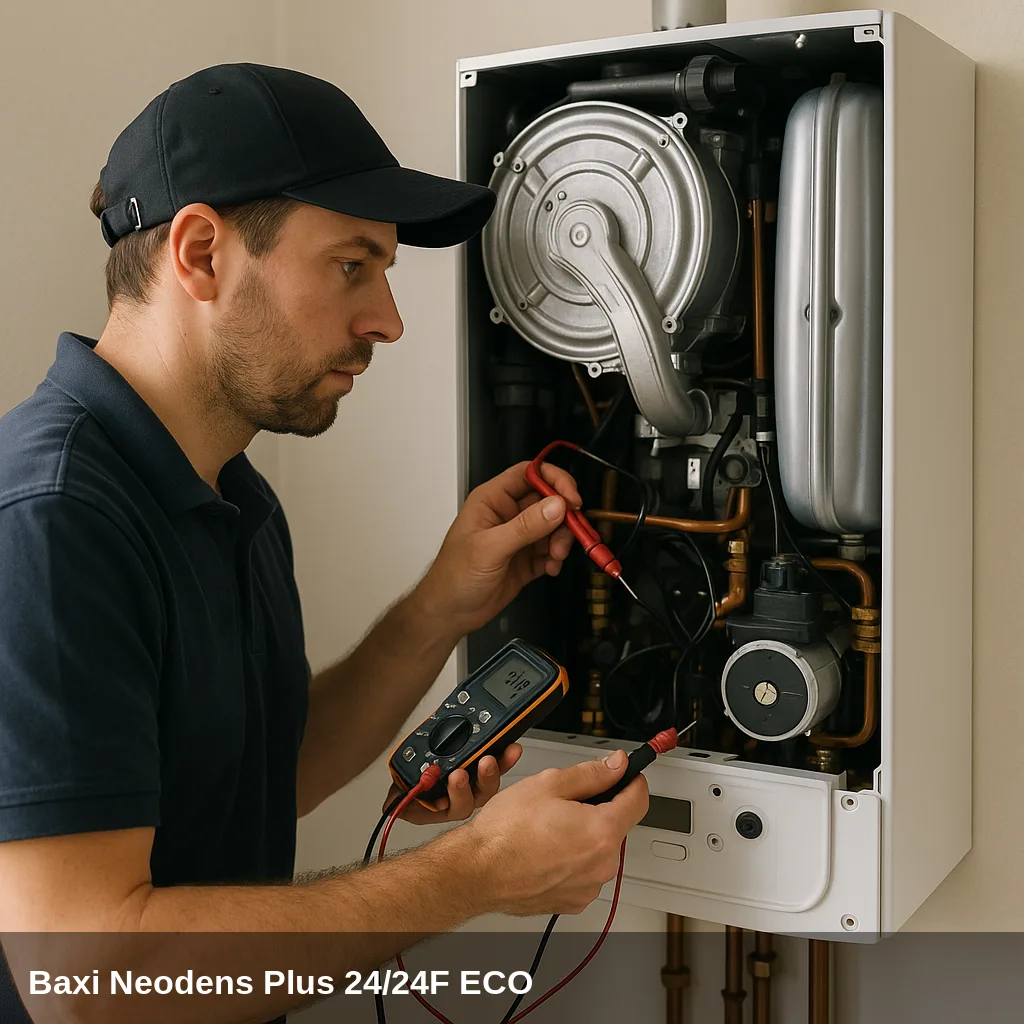
Fault codes related to sensors, electronics, gas valve, fan, or flue gas evacuation require a qualified technician with the appropriate equipment. If the same fault code reappears after a reset, or if the pressure drops repeatedly, a professional inspection is advisable. In Uniclima do you find spare parts for this boiler.
Frequently Asked Questions
The correct operating pressure is between 1.0 and 1.5 bar with the boiler cold. If the pressure gauge reads less than 1 bar, slowly open the filling valve until reaching that range and then close it. If it repeatedly drops, there may be a leak and it is advisable to check the installation.
Locate the reset button (marked with the flame symbol or the letter R on the front panel) and hold it down for 2-3 seconds. Only attempt a single reset; if the fault reappears immediately, do not repeat the reset and contact technical service, as insisting may mask the real problem.
Without tampering with internal components, the user can check: (1) that the gas supply is open by verifying that other gas appliances are working; (2) that the pressure on the pressure gauge is between 1 and 1.5 bar and refill if necessary; (3) that the external flue outlet is not obstructed by ice, dirt, or nests; (4) that the boiler's electrical switch and the circuit breaker on the panel have not tripped. Any intervention on internal components requires a qualified technician.
Fault code E133 indicates that the boiler has made 5 ignition attempts without detecting a flame. The most common causes are: main gas valve closed, insufficient gas pressure in the network, air in the gas pipes (common after supply interruptions), or a deteriorated ignition electrode. First, check that the gas supply is reaching correctly; if the cause is not evident, a qualified technician should inspect the electrode and the gas valve.