


Short answer
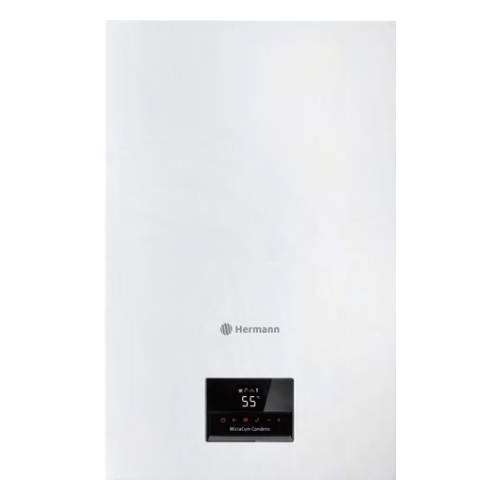
Hermann MicraCom Condens AS/2 faults
Identify the code and check the version of your boiler.
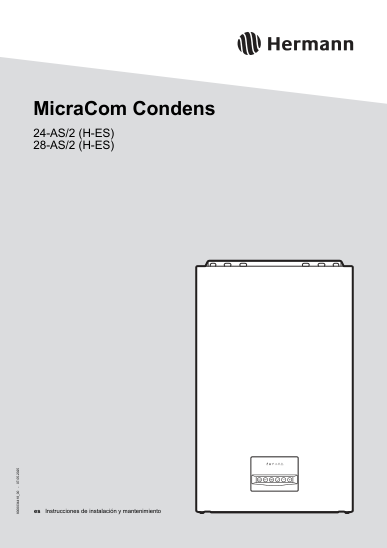
Models and version of the manual
24-AS/2 and 28-AS/2. Documentation for the AS/2 generation of 2025. Check the suffix of the PCB: this guide does not consider AS/1 and AS/2 as equivalents.
Consulted edition: 8000034418_00 · 07/05/2025 · manufacturer's manualThe control options, accessories, and versions may limit which notifications appear in each installation.
Locate the code on your screen.
These accesses lead to their entry in the table. They are not a classification of the most common faults: the manual does not provide incidence statistics.
- F.22
Installation pressure too low
- F.28
Failed ignition
- F.29
Ignition and control error during operation, the flame is off.
- F.75
Pump fault/water shortage
What to do without opening the boiler
- Note what you see.
Complete code, message, and pressure displayed by the equipment. Indicate whether it occurs when opening hot water, requesting heating, or in both cases.
- Identify the device.
Take a photo of the screen and the identification accessible without disassembling anything. Brand, model, and version help avoid confusing tables from different ranges.
- Describe how it started.
Determine whether the fault is continuous or intermittent and if there was a supply interruption or a recent intervention. If it reappears after a reset allowed by the user manual, do not chain resets.
Do not open the casing or manipulate gas, wiring, combustion, or flue gas outlet. If you smell gas, avoid flames and switches, leave the area, and notify the distributor's emergency service from a safe location; in case of immediate danger, call 112.
Hermann MicraCom Condens AS/2 components Manufacturer's diagram
Documented codes table
The meaning of the warning is provided, not the repair operations reserved for qualified personnel. When the manufacturer groups several codes, the grouping is maintained; it is not interpreted as a range of numbers.
| Code | What does it indicate? |
|---|---|
| F.00 | Flow temperature sensor interruption |
| F.01 | Return temperature sensor interruption |
| F.10 | Short circuit of the supply temperature sensor. |
| F.11 | Return temperature sensor short circuit |
| F.13 | Short circuit in the accumulator temperature sensor. |
| F.20 | Safety disconnection of the temperature limiter |
| F.22 | Installation pressure too low |
| F.23 | Safety shutdown: excessive temperature variation |
| F.24 | Safety disconnection, temperature rise too fast |
| F.25 | Safety disconnection: flue gas temperature very high |
| F.27 | Safety disconnection, flame simulation |
| F.28 | Failed ignition |
| F.29 | Ignition and control error during operation, the flame is off. |
| F.32 | Fault: fan |
| F.33 | Excessive pressure losses in the air intake/exhaust gas system |
| F.46 | Short circuit of the cold water sensor |
| F.49 | Fault: eBUS |
| F.61 | Fuel control valve error |
| F.62 | Error, delayed disconnection of the fuel control valve |
| F.63 | Fault: EEPROM |
| F.64 | Fault, electronics/temperature sensor |
| F.65 | Electronic temperature fault |
| F.67 | Fault: electronics/flame |
| F.68 | Fault: unstable flame signal |
| F.70 | Invalid device identification (DSN: "Device Specific Number") |
| F.71 | Fault in the supply temperature sensor |
| F.72 | Fault, return temperature sensor |
| F.73 | Water pressure sensor signal out of range (too low) |
| F.74 | Water pressure sensor signal out of range (too high) |
| F.75 | Pump fault/water shortage |
| F.76 | Fault, thermal device lock |
| F.77 | Fault, anti-return flap for combustion gases/condensate pump |
| F.78 | Interruption of the domestic hot water outlet temperature sensor with external control |
| F.83 | NTC temperature fluctuation fault |
| F.84 | The NTC temperature difference is unbelievable. |
| F.85 | Incorrectly mounted (swapped) supply and return temperature sensors |
| F.86 | External safety disconnection |
| F.87 | Ignition electrode fault |
| F.88 | Fault in the gas valve |
| F.89 | Fault in the pump |
| F.97 | Main PCB self-check fault |
No matches found. Please check the code and the version of the equipment.
Is there a problem, but no fault code appears?
The absence of a warning does not rule out a fault. For a boiler that does not heat, does not deliver hot water, loses pressure, or operates intermittently, describe the symptom and the moment it occurs. Do not assume that the PCB, the pump, or a sensor is faulty without checking the equipment and the installation.
Request a review of the boiler. · Consult maintenance
Before requesting a repair
Does the code identify the spare part I need to buy?
No. A single warning can have multiple causes. The spare part reference requires identifying the appliance and confirming the fault; the code or a generic photograph is not sufficient.
Can it be reset again if the fault returns?
It is not advisable to chain resets. Follow only what is outlined for the user in your version's manual. A persistent or recurring lockout requires inspection.
When does it make sense to compare a new boiler?
When you have a diagnosis and a budget, compare repair, availability of the spare part, and replacement according to your installation. An isolated fault code does not justify changing the equipment.
Models of this guide in the catalog
See new boilers · Consult installation or replacement
The technical sheet of each product provides information on its price and availability. Installation is quoted separately depending on the case.
Does the warning still appear on your Hermann boiler? Consult the Hermann boiler repair in Madrid or the spare parts Hermann by reference.
Documentation and other guides
Consult fault guides by brand and model. · Return to the blog